
Private Stress Echocardiogram in Peterborough, Corby and London
Consultant-Led Exercise Stress Echo
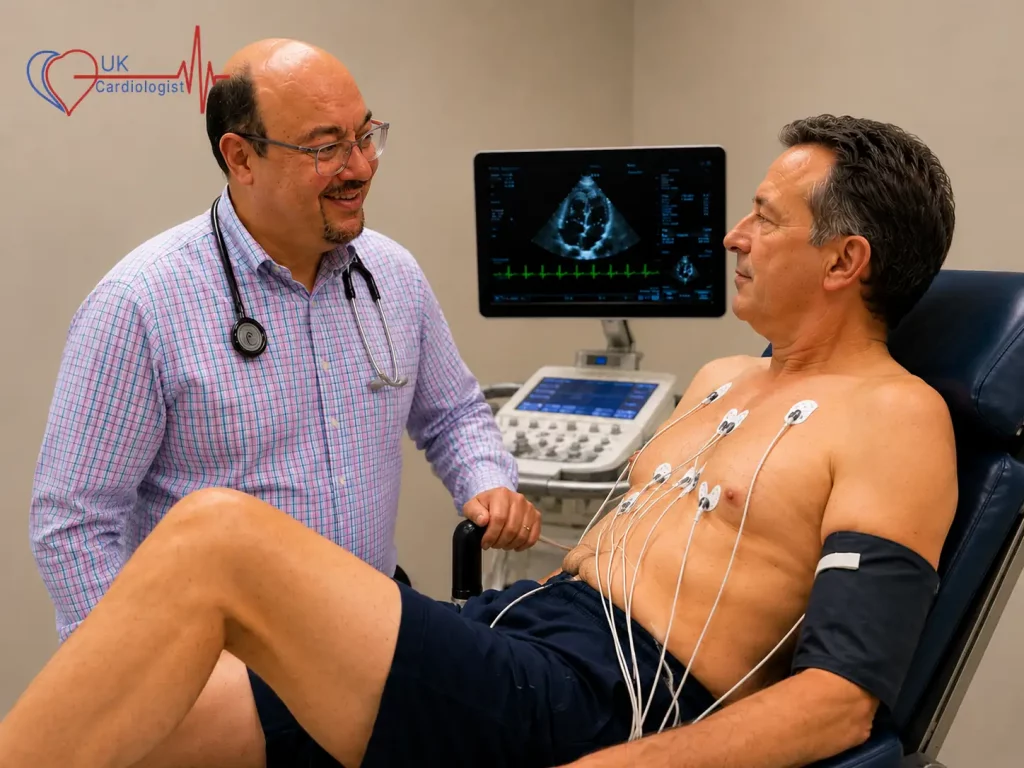
Arrange a private exercise stress echocardiogram in Peterborough, Corby or London with Dr Salam Salloum, Consultant Cardiologist (GMC 5209498). The test combines detailed ultrasound imaging with controlled exercise, usually on a bicycle, to assess how your heart performs as its workload increases.
Available in Peterborough, Corby and London. Self-referral, GP referral and consultant referral are all accepted.
Stress echocardiography can help evaluate selected patients with exertional chest discomfort or breathlessness, possible reduced blood supply to the heart muscle, heart valve disease, and concerns about heart function during exercise. Findings are interpreted alongside your symptoms, medical history and other investigations.
Most appointments take approximately 45–60 minutes. Your findings will normally be explained after the test and a clear written report will be provided.
Clinical suitability is reviewed before testing. This service is not for medical emergencies. If you have severe or persistent chest pain, severe breathlessness, collapse or other acute symptoms, call 999.
Price on enquiry
What Can a Stress Echocardiogram Assess?
A stress echocardiogram provides information that may not be apparent when the heart is examined only at rest. Depending on the clinical question, it can help assess:
- exertional chest discomfort or breathlessness;
- signs of reduced blood supply to the heart muscle during exercise, known as inducible ischaemia;
- heart-muscle contraction and pumping function as workload increases;
- how heart-valve disease behaves during exertion;
- exercise capacity and the heart-rate, blood-pressure and ECG response; and
- selected patients before surgery or following previous cardiac treatment.
No single investigation can confirm or exclude every cause of cardiac symptoms. The result is therefore considered together with your history, examination and any other tests, and further assessment may occasionally be recommended.
Why Choose a Bicycle Stress Echo?
A bicycle stress echo allows ultrasound images to be obtained repeatedly while you are exercising. This gives the cardiologist a direct view of how heart-muscle movement, valve function and overall cardiac performance change as the workload increases.
The exercise level is increased gradually and adapted to your fitness and mobility. Your ECG, heart rate, blood pressure and symptoms are monitored throughout. If you cannot exercise sufficiently to answer the clinical question, the test may be inconclusive and a different investigation may be advised.
The most appropriate protocol depends on your symptoms, medical history and the reason for referral. Suitability is reviewed before your appointment.
How to Prepare for Your Appointment
You will receive instructions tailored to your clinical circumstances. In general:
- Clothing: wear comfortable two-piece clothing and suitable footwear for cycling.
- Food and drink: avoid a heavy meal and caffeine for approximately 2–3 hours before the appointment, unless you are advised otherwise. Water is usually permitted.
- Medication: continue your usual medicines unless the clinical team specifically asks you to change them. Do not stop beta-blockers or any other prescribed treatment on your own.
- Clinical information: bring an up-to-date medication list, any referral letter you have and any relevant previous cardiac reports.
- Insurance: if using private medical insurance, check whether pre-authorisation is required and bring the authorisation details.
Please contact the team before attending if your symptoms have significantly changed, you have become acutely unwell or you have concerns about your ability to exercise.
What Happens During the Test?
- Clinical review and consent: the reason for the test, your symptoms, medical history and suitability for exercise are reviewed.
- Resting assessment: a resting ECG, blood pressure and echocardiogram are obtained to establish a baseline.
- Graded exercise: you exercise on the bicycle while the workload is increased gradually. ECG, heart rate, blood pressure and symptoms are monitored.
- Stress imaging: ultrasound images are acquired during increasing levels of exercise and compared with the resting images.
- Recovery and discussion: monitoring continues during recovery, after which the initial findings are explained.
The test is stopped when enough diagnostic information has been obtained, your target workload has been reached, or there is a clinical reason to stop. Most appointments last around 45–60 minutes, although the exercise phase is usually much shorter. No ionising radiation is used.
Who May Benefit From a Stress Echo?
A stress echo may be considered for selected patients with:
- chest pain, tightness or breathlessness brought on by exertion;
- suspected or known coronary artery disease when an imaging-based functional assessment is appropriate;
- heart-valve disease where symptoms or severity during exercise need clarification;
- unexplained limitation in exercise capacity;
- a need for cardiac risk assessment before certain operations; or
- new or recurrent symptoms after previous cardiac treatment.
Stress echocardiography is not the right investigation for every patient. The most appropriate test depends on your symptoms, likelihood of coronary disease, ability to exercise, resting ECG and echocardiogram, and any previous investigations. Clinical information is reviewed before the appointment.
Consultant-Led Results and Next Steps
Your stress echocardiogram is supervised and interpreted by Dr Salam Salloum, Consultant Cardiologist. The findings are normally explained on the same day, and a clear written report is provided. If the study requires additional review, you will be told when the final report will follow.
The result is considered alongside your symptoms and clinical history. If the findings are abnormal, equivocal or do not fully answer the clinical question, the next step may be a cardiology consultation, treatment review or another investigation such as coronary CT angiography. Recommendations are individualised rather than based on the scan alone.
Safety and important information
Stress echocardiography is generally well tolerated in appropriately selected patients, but it deliberately increases the heart’s workload. Chest discomfort, breathlessness, dizziness, rhythm disturbance or blood-pressure changes can occur, and serious complications are uncommon but possible. Your ECG, blood pressure and symptoms are monitored, and the test is stopped promptly if there is a clinical concern.
The benefits, limitations and relevant risks will be discussed as part of the consent process. A stress echo does not replace a full clinical assessment and cannot exclude every possible cause of chest symptoms.
For severe or persistent chest pain, marked breathlessness, collapse or other acute symptoms, call 999 rather than booking this service.
Related cardiology services
Depending on your needs, you may also benefit from a face-to-face cardiology consultation, a video consultation, a telephone consultation or professional ECG reporting.
You may also be interested in our exercise ECG (treadmill test) and echocardiogram services.
Where you can have the test:
- Peterborough: The Hamptons Hospital, Cygnet Business Park, Cygnet Road, Hampton, Peterborough PE7 8FD
- Corby: Innovate Diagnostics, Corby Innovation Hub, Bangrave Road South, Weldon, Corby NN17 1NN
- London: The National Heart Clinic, 69 Harley Street, London W1G 8QW
Appointments: in London, stress echo appointments are available almost every day. In Peterborough and Corby, appointments are arranged on request after a discussion with the team.
Referral: you can book yourself (self-referral) or be referred by your GP or another consultant.
Cost: the fee can differ between locations, so please contact us and we will confirm the total cost before you book.
Ready to arrange your assessment? Use the booking options above or contact the team to discuss the most appropriate next step.
Get in touch
Chat on WhatsApp
+44 7939 345840
Trusted by patients across the UK

Personalised care
Your test is planned around your symptoms and history.

Consultant-led testing
Performed and reported by a consultant cardiologist.

Same-day explanation
Your results are explained to you on the day.

Advanced cardiac imaging
Specialist in stress echo, echo, cardiac CT and MRI.
Stress Echocardiogram FAQs
What is a stress echocardiogram?
A stress echocardiogram combines ultrasound imaging of the heart with controlled exercise. Images obtained at rest and during increasing workload show how the heart muscle and valves respond when the heart is working harder.
What can a stress echo help assess?
Depending on the clinical question, it can help assess signs of inducible ischaemia, heart-muscle contraction, pumping function, valve performance and the ECG, blood-pressure and symptom response to exercise. The result must be interpreted with your clinical history and other investigations.
Is a stress echo painful?
The ultrasound itself is not painful. You should expect to work progressively harder on the bicycle and may feel tired or breathless. Tell the clinical team immediately about chest discomfort, dizziness or any other concerning symptom.
How long does the appointment take?
Most appointments take approximately 45–60 minutes. The exercise phase is usually much shorter; the remaining time is used for clinical review, resting measurements, imaging, recovery and discussion of the findings.
Where can I have a stress echo?
A stress echo can be arranged in Peterborough, Corby and London. In London, appointments are available almost every day. In Peterborough and Corby, appointments are arranged on request after a discussion with the team.
Do I need a referral?
No. You can book yourself (self-referral), or be referred by your GP or another consultant. If you are using private medical insurance, check with your insurer first, because some require a referral or pre-authorisation.
How should I prepare for the test?
Wear comfortable two-piece clothing and suitable footwear for cycling. Bring your medication list, any referral letter and relevant previous cardiac reports. You will receive personalised instructions about food, caffeine and medicines before attending.
Should I stop any medication beforehand?
Do not stop any prescribed medicine unless the clinical team specifically advises you to do so. Some treatments can affect the heart-rate response to exercise, so your instructions will depend on the purpose of the test and your medical circumstances.
Can I eat or drink before the test?
Avoid a heavy meal and caffeine for approximately 2–3 hours before the appointment unless you are advised otherwise. Water is usually permitted. Follow the personalised instructions provided when your appointment is confirmed.
What happens during a bicycle stress echo?
After a clinical review, resting ECG, blood pressure and ultrasound images are obtained. You then exercise on a bicycle while the workload increases gradually. ECG, blood pressure, symptoms and ultrasound images are monitored before a recovery period and discussion of the initial findings.
Is a stress echocardiogram safe?
Stress echocardiography is generally well tolerated in appropriately selected patients, but it deliberately increases the heart’s workload and complications are possible. Your ECG, blood pressure and symptoms are monitored, the test is stopped if concerns arise, and the relevant benefits and risks are discussed during consent.
What if I cannot exercise enough?
The workload is adapted to your ability. If you cannot reach a level that answers the clinical question, the result may be inconclusive and Dr Salloum may recommend a different investigation or further clinical assessment.
When will I receive the results?
The initial findings are normally explained on the same day after the test. A clear written report is also provided. If the study needs additional detailed review, you will be told when the final report will follow.
Will I receive a written report?
Yes. The report summarises the stress echo findings and any recommended next steps. It can be shared with your GP, referring clinician or other healthcare professional involved in your care.
How is a stress echo different from a standard echocardiogram?
A standard echocardiogram assesses the heart at rest. A stress echocardiogram adds controlled exercise and repeat imaging, helping show changes that may only appear when the heart’s workload increases.
How does stress echo differ from a treadmill ECG?
A treadmill ECG records electrical activity and the exercise response but does not image the heart. Stress echocardiography also assesses heart-muscle movement, pumping function and valve behaviour. The most appropriate test depends on the clinical question and the individual patient.
Can I drive or return to work afterwards?
There is usually no sedation, and most people can drive and resume normal activities after an uncomplicated test. Follow the advice given on the day. If you remain unwell or are advised not to drive, arrange alternative transport and delay returning to work.
Will private medical insurance cover the test?
Cover depends on your insurer, policy and clinical indication. Contact your insurer before booking to confirm benefits and obtain any required pre-authorisation. A self-funded option is also available; please contact us for the fee, which we will confirm before you book.
Medically reviewed by Dr Salam Salloum, Consultant Cardiologist. Last updated: . This page is for general information and does not replace personal medical advice.